



His Contributions
- ???label.link.share???
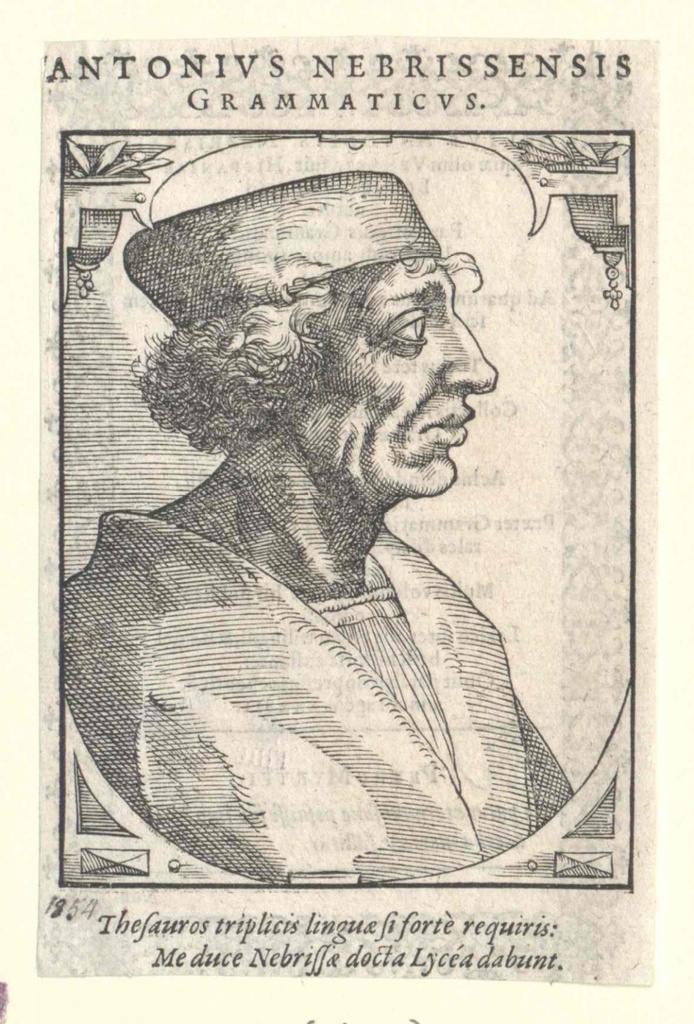
Without a doubt, the contributions made by Elio Antonio de Nebrija were numerous and valuable to the world of philology and humanities. This is so not only because of the endless number of works of all kinds of disciplines he coined, but also for the innovations they brought with them, which meant a transformation of the principles of his time.
Perhaps his most groundbreaking and famous contribution was the elaboration of the Grammar of the Castilian language, published on August 18th, 1492. This work is essential for universal history due to its revolutionary nature, since it is the first grammar not only about the Castilian language, but about a vernacular one. Prior to that time, there were only grammars of languages considered highly cultivated, such as Latin, Greek and Hebrew. Consequently, this publication, which served as a model for other languages, dignified a Romance language such as the Spanish one.
Besides, this grammar relied on Isabella’s, the Catholic Queen, approval to whom it was dedicated. She considered it would be useful to spread the Castilian language in the New World. However, it was not until the 18th century that this grammar was valued as it is today since it was not as successful as the Latin-Spanish and Spanish-Latin dictionaries already were at the time.
Another major contribution in the field of Philology was the creation of the Castilian language spelling rules (1517). This work was based on the principle of writing in the same way as the language is spoken, an idea that spreads up to now and it involved a total renovation: “we have to write in the same way as we speak and speak as we write”.
In the educational field, Nebrija left many transformations in the pedagogical method which came from an intellectual programme. After his stay in Bolonia he proclaimed himself reformist of the Hispanic letters; he taught Grammar, Oratory and Poetry as revolutionary subjects in his lessons although they were underestimated at that time. Moreover, Nebrija wrote several works based on his teaching experience; for example, Introductiones Latinae (1481), a successful editorial work that helped many students to learn Latin.
It is interesting to understand that Nebrija never perceived science as something isolated from humanities, but rather as a mutual feedback from both worlds. Therefore, he considered appropriate for grammarians to influence any scientific discipline from the philological point of view. Some examples of this are the numerous writings on metrology (numbers, weights and measures), cosmography, botany or the reform of the calendar he wrote. Another evidence of this is the successful work Table of the diversity of days and times and hour parts (1516-1517), which he wrote in his old age in order to serve as a consultation to know the length of the day throughout the year in different geographical locations.
Our humanist was so endlessly inquisitive that he also became interested in Archeology, resulting in a project on the Spain antiquities, Antiquitates Hispanienses (1498).
We cannot overlook another contribution that was undoubtedly central in his life: his research on the Bible. As a great erudite in this subject and thanks to his collaboration in the Complutense Polyglot Bible project, promoted by Cardinal Cisneros, he achieved a multitude of translations, corrections and critical revisions of the Vulgate. His approach to the Hebrew language in relation to the Sacred Scriptures led him to publish the litteris Hebraicis cum quibusdam annotationibus Scripturam Sacram in 1515, which includes treatises on Hebrew phonetics, New Testament vocabularies or a Latin accentuation dictionary of root words of Hebrew.
Nevertheless, this is just a glimpse of the vast comprehensive work of Elio Antonio de Nebrija. He was a teacher, grammarian, forerunner of intellectual property rights, editor, poet, Royal historian, promoter of the first printing press in Salamanca, participant in the creation of the statutes of the University of Alcalá de Henares and member of the Complutense Polyglot Bible project. Moreover, the creation of the Tanto Monta (a Spanish saying meaning “it makes no difference”) of the Catholic Monarchs was attributed to him, although this fact has been widely questioned. These examples and contributions are just some of the vital manifestations of Elio Antonio de Nebrija. The enormous versatility of our humanist and his unquestionable relevance have led to the creation of an important universal figure not only for Hispanic letters, but also for universal letters.