



Biography
- ???label.link.share???
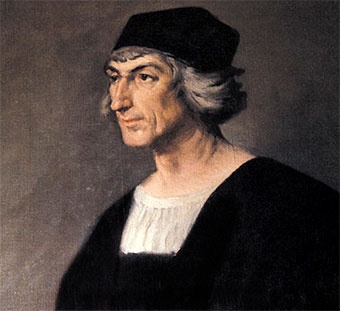
Antonio de Cala y Jarana, better known as Elio Antonio de Nebrija (Lebrija, 1444? - Alcalá de Henares, 1522) was an important humanist and philologist, who stood out for his multidisciplinary personality, whose legacy has survived until our days.
Born into a wealthy family, he spent his childhood in his hometown , Lebrija, which he extensively praised in reference to its Roman origins, was at that time called Nebrissa Veneria, on which he based his name and surname with the structure of Roman name: Aelius Antonius Nebrissensis. He studied Latin grammar and logic being Lebrija the town where he started his academic and intellectual career.
Moved by his desire for knowledge, he went to the University of Salamanca in order to study theology as a sage. He then turned to more humanistic studies after his stay in the Spanish’s College in Italy, where he went in depth in his knowledge of the Sacred Scriptures, the Latin language and where he discovered Hebrew. He returned from Italy with the idea of “restoring the values of Latin” and renewing the intellectual principles of his surroundings.
Upon his return to Spain, he became Juan Rodríguez de Fonseca´s tutor, who was Alonso de Fonseca´s nephew. However, after the death of the latter, he began to lecture Poetry lessons at the University of Salamanca at around 1475. A year later, he competed for the tenure of the Chair of Grammar, which he obtained thanks to his own merits. Nebrija entered the University of Salamanca as a breath of fresh air, since his pedagogical methodology was considered modern and innovative within the archaic and traditional academic world in Castile.
After marrying Isabel de Montesino o de Solís in 1487, with whom he had nine children, he joined the Court of Don Juan Zuñiga, Grand Master of the Order of Alcántara. During this period, Nebrija increased his grammar and literary production.
In addition, due to his friendship with Father Hernando de Talavera, Nebrija got in touch with the Court of the Catholic Monarchs. This situation gave him the privilege of being named Royal historian in 1509. Likewise, this relationship of trust allowed him to present his project on Spanish Grammar to Isabella, the Catholic Queen, who gave him her approval.
After Zuniga’s death, he went back to the already modernized University of Salamanca where he would be employed as a Grammar lecturer. Nonetheless, following some absences from his position and other works he was involved in, Nebrija left Salamanca when Cardenal Cisneros summoned him. Cardenal Cisneros was, at that time, building a University in Alcalá de Henares and he was creating a team of scholars who would carry out Bible studies, the so-called Multilingual Bible from Alcalá de Henares. Nebrija was the perfect scholar to embark on this project thanks to his interest in the grammatical study of the Sacred Scriptures and his knowledge of Hebrew, which had brought some accusations from the Inquisition in the past. His contact with the publishing world was also noticeable. Thanks to his alliance with the printer Arnao Guillen de Brocar, Nebrija witnessed the printing and editing of his own works. Similarly, he was the pioneer in obtaining the intellectual rights of his works.
After his death in Alcalá de Henares in 1522, where he was a lecturer at University, he left a wide legacy of works both in Latin and Spanish. These works show his interest in different disciplines such as medicine, archeology, poetry, the Bible, grammar and language among many others.